Your Meta ads campaign structure is the highest-impact decision you make before a single dollar goes live. Get it right and Meta's machine learning has a clean, dense signal to optimize against. Get it wrong and you fragment budget, starve ad sets, and fight the algorithm.
Most accounts we audit break the same way. They run too many campaigns and split one audience across too many ad sets. No single ad set ever collects enough conversions to stabilize.
Meta's Andromeda update rewired how ads get matched to people. Per Meta's own engineering team, advertisers who newly turned on Advantage+ creative's AI-driven targeting saw a 22% increase in ROAS (return on ad spend). That shift rewards simple accounts that feed the system volume.
This guide lays out the account and Meta ad campaigns structure we run at Flighted in 2026. It covers testing, scaling, and audience decisions for DTC, plus a dedicated B2B SaaS variant, with every rule anchored to a threshold. For vertical detail, see our guides for supplement brands, telehealth, and B2B SaaS.
This is written for operators spending five to six figures a month. If you run Meta in-house or manage it for clients, the thresholds below are the ones we act on. Read it as a build spec, not theory.
Essential Takeaways:
Segmenting your account into "Test" and "Scale" campaigns is essential to allow for high creative testing velocity, without resetting your largest campaigns into the learning phase
Meta can now handle a larger volume of ads per adset - your highest spending campaigns can handle more creative than ever before
You don't need to segment ads by format (static and video) - simply consolidate your top performing ads together, and trust Meta's Advantage+ Targeting to build a cohesive funnel in a single adset with your creative
Test a wide array of audience targeting including Advantage+, Broad, themed interest stacks, and varying Lookalike sources and sizes (1 to 3 percent tend to work best)
Spend less on retargeting than you would assume
Start With The Philosophy Behind This Structure
If you're new to Meta advertising, understand the principles before the diagram, because every structural rule below flows from them. Master these and you'll operate above most Meta advertisers.
Simple structures win. Every extra campaign, ad set, and exclusion is another constraint on Meta's delivery and another place for the learning phase to reset. The algorithm performs best with a clean, consolidated surface to optimise against, which is why the entire structure below reduces to three campaigns.
Machine learning runs on data density. Meta's delivery learns from conversion volume. Splitting the same budget across many small ad sets starves each one of signal; consolidating spend into fewer, well-fed ad sets gets you out of the learning phase and into stable delivery faster.
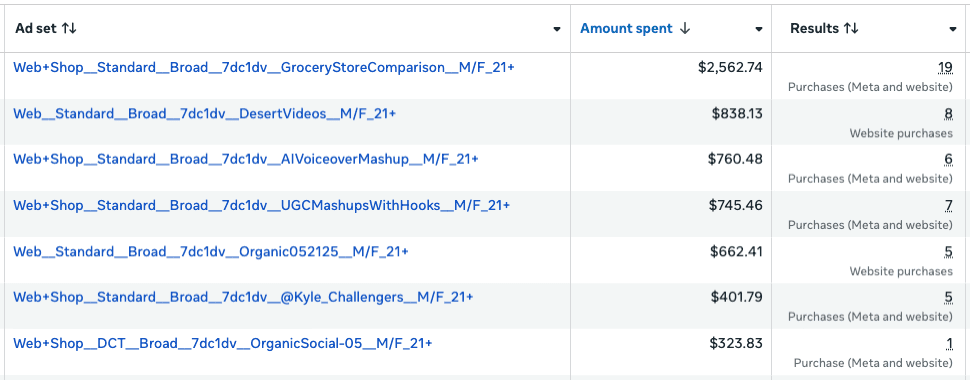
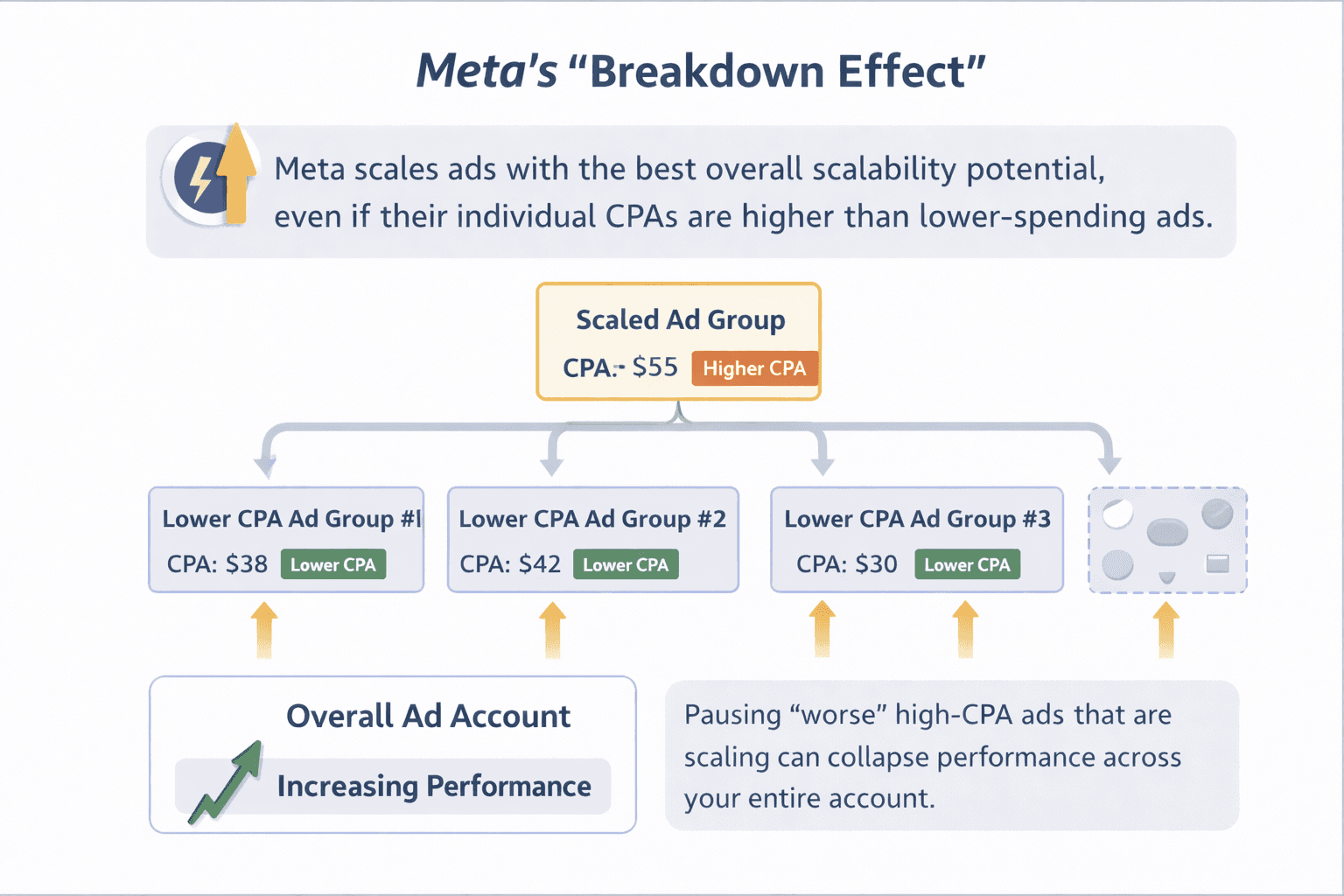
Respect the Breakdown Effect. The ads driving the most value in your account often display the worst in-platform ROAS or CPA numbers, because Meta strategically pushes spend toward ads with the highest scaling potential. A beginner's instinct is to pause the high-spend, "inefficient" ad and force budget into the efficient-looking ones. That's almost always a mistake: the high spender is usually the incrementality driver introducing your brand to new audiences, while the efficient-looking ads close sales it originated. Pause it and the whole ad set can collapse. This is covered in depth in the Identifying Winning Ads section below.
Think in incrementality, not attribution. Platform-reported numbers tell you what Meta claims; incrementality tells you what your ads actually caused. Judge the account on blended results and new-customer reach, not on which ad set wins the attribution race.
Protect funnel health. An account that only harvests warm demand will look efficient right up until it stalls. Watch First-Time Impression Rate and keep dedicated pressure on new-to-file reach, which is exactly what the Top-of-Funnel campaign below exists to do.
The 2026 DTC Account Structure At a Glance
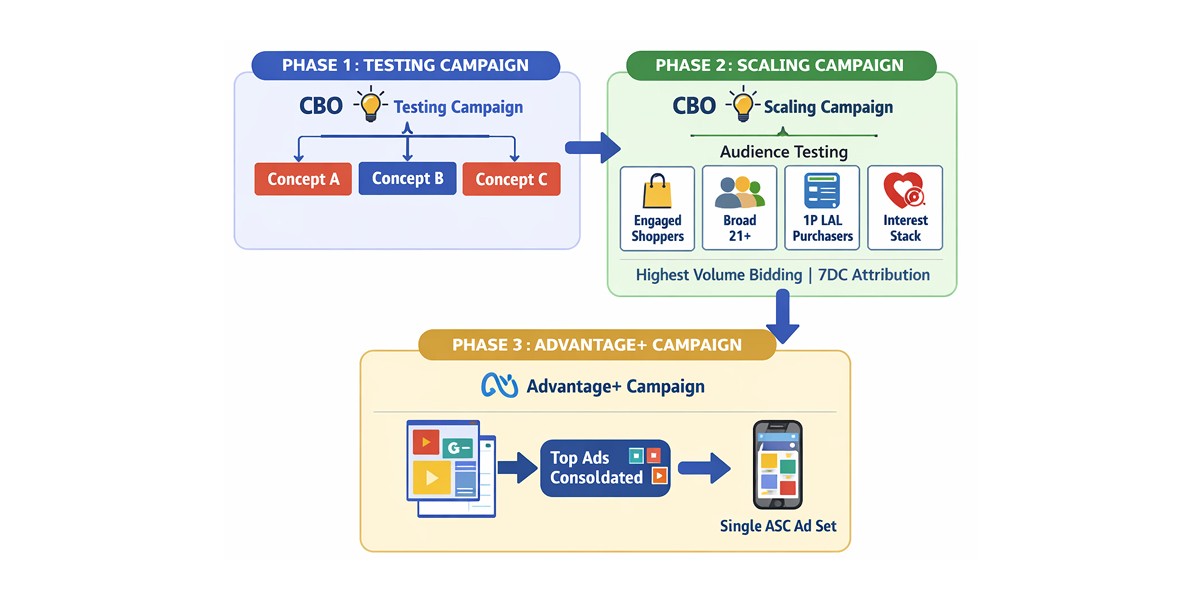
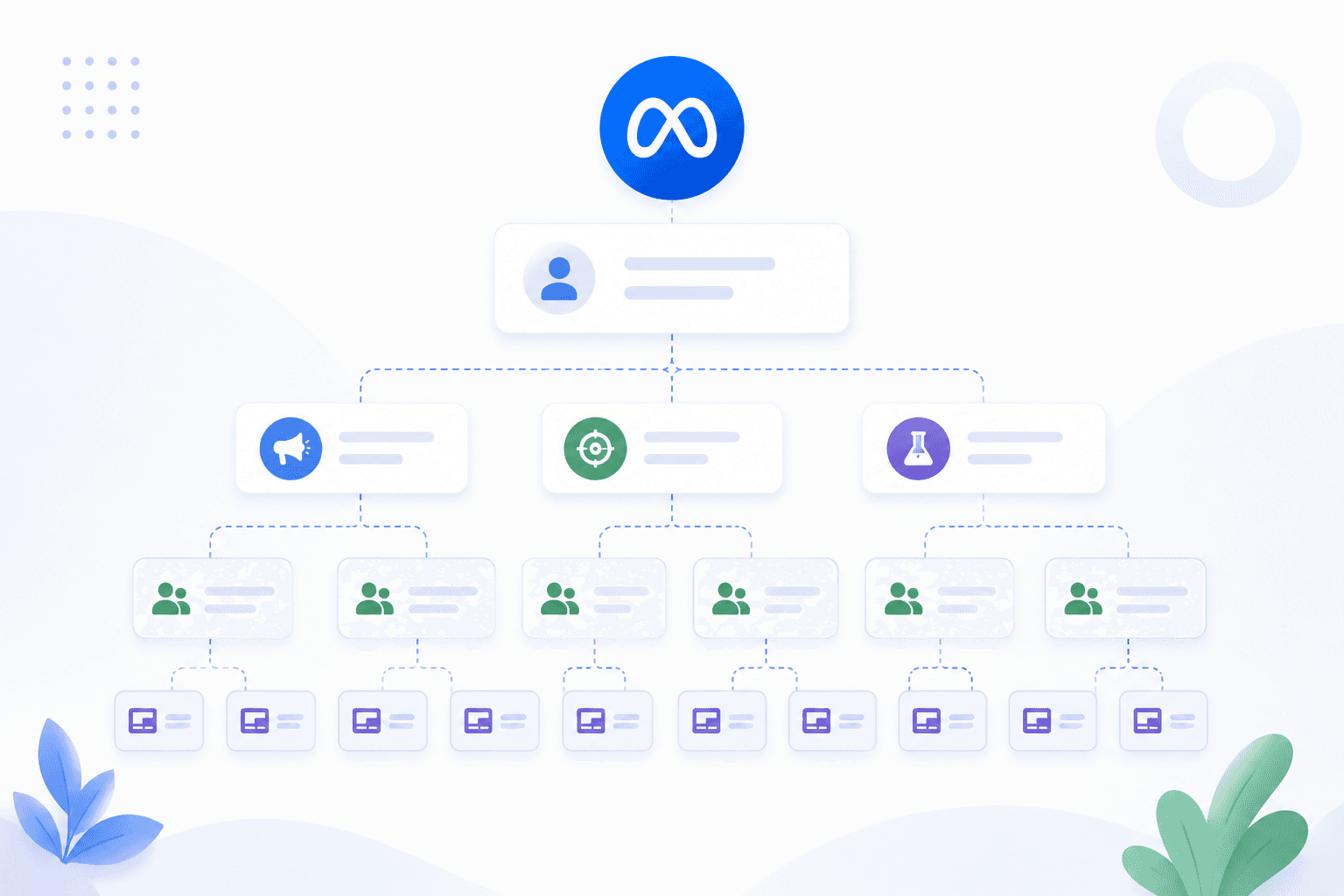
Skip the theory for a second, here's the structure itself. Most DTC brands spending $5K-$100K/month should run exactly three campaigns:
Campaign 1: Sandbox / Test (CBO)
Budget: 25% of total daily spend
Structure: One ad set per creative concept, grouped by theme or format
Purpose: Identify likely winners at roughly $20 spend per concept, independent of your overall budget
Campaign 2: Winners (CBO)
Budget: The majority of remaining spend
Structure: One consolidated adset holding only proven post-ID winners from Sandbox, tested across audience types (Broad, Advantage+, Lookalike Stacks, Purchaser Lookalikes)
Purpose: Your primary scale engine, held stable on creative, variable on audience
Campaign 3: Top-of-Funnel
Budget: Sized to keep your blended First-Time Impression Rate above 60% account-wide
Structure: Exclude every audience you can, website visitors, existing customers, ad engagers, past converters, the works. This campaign exists to reach people your account hasn't touched yet.
Optimization event: An upper-funnel signal like Add-to-Cart rather than Purchase. Forcing this campaign to optimize for last-click conversion defeats its purpose, it needs room to reach cold, unproven audiences without Meta immediately narrowing back toward your warmest prospects.
Purpose: Without a dedicated campaign actively pushing for new-to-file reach, your Winners campaign will quietly drift toward the easiest, most familiar audiences over time, First-Time Impression Rate decays, and your total addressable audience shrinks even as in-platform ROAS looks fine. This campaign is the counterweight.
Retargeting: deliberately not a fourth campaign, yet. Skip a dedicated retargeting build entirely until you're spending close to $1K/day across Sandbox + Winners + Top-of-Funnel combined. Below that threshold, exclusion match rates are unreliable enough post-iOS 14 that your Winners campaign is already recapturing a meaningful share of warm traffic without a second budget line. Once you cross that spend level, add retargeting at under 10% of total budget, cart-abandonment and high-value SKUs only, not a general warm-audience catch-all.
Structure By Spend Level
The campaign structure barely changes as you scale. What changes is how many ad sets each campaign holds and how much creative you feed them.
Monthly Spend
Recommended Campaigns
Notes
Under $5K
Sandbox + Winners
One combined top-of-funnel push; keep ad sets few.
$5K–$25K
Sandbox + Winners + Top-of-Funnel
Full three-campaign spine; still no dedicated retargeting.
$25K–$100K
Same three campaigns, more ad sets
Add retargeting under 10% once past ~$1K/day.
$100K+
Three campaigns plus Advantage+ tests
Break Advantage+ into its own campaign for clean reads.
The temptation at every level is to add campaigns, but resist it. Adding budget to your existing ad sets almost always beats spinning up new ones, because it feeds the learning phase. Only add structure once a single ad set is genuinely over-fed.
Keep naming and reporting boring on purpose. Use a consistent convention so anyone can read the account at a glance. A predictable structure is easier to audit, hand off, and scale than a clever one.
Top-Of-Funnel Structure For A New DTC Brand
New DTC brands have no purchase history, so treat the top of funnel as a data-gathering engine. Exclude all warm audiences. You want net-new prospects only.
Set the exclusions deliberately. Exclude website visitors, past purchasers, email lists, and social engagers. A new brand has little warm audience to spare, and leaks into the top of funnel inflate your reported results.
Optimize for an upper-funnel event, Add-to-Cart, not Purchase. Early on you will not generate enough purchases to teach the algorithm, so a cheaper mid-funnel event gets you to volume faster. For the sequencing logic, see our upper-funnel Meta ads strategy guide.
Keep blended FTIR above 60% so you keep reaching fresh users. Then size the budget from learning-phase math: Meta wants about 50 conversions per ad set per week to exit the learning phase. Ramp toward that number and hit roughly 25 per week by mid-month.
A conservative first-month CPA estimate is roughly your product price. An $80 product at 25 conversions per week runs ($80 × 25) × 4 weeks, or about $8,000 per month. Our bare-minimum engagement floor is about $250 per day.
Do the arithmetic before you launch, not after. If your budget cannot buy roughly 25 conversions a week at your expected CPA, the ad set never leaves learning. When budget is tight, optimize for a cheaper event so you still clear the weekly bar.
As purchase volume builds, move the optimization event down the funnel toward Purchase. Do it in one step, not gradually, and give the ad set a fresh week to relearn. Rushing this shift is how new brands stall their first scale.
How To Test New Ads on Meta
To maintain a high testing velocity without compromising performance, follow these "Sandbox" campaign rules:
Budget: Limit spend to 25% of your total daily ad spend.
Structure: Group ad sets by distinct creative themes or formats.
Optimization: Use Campaign Budget Optimization (CBO) to let Meta find the best variants.
Spend Minimums: Apply ad set spend minimums only if a concept isn't getting enough delivery.
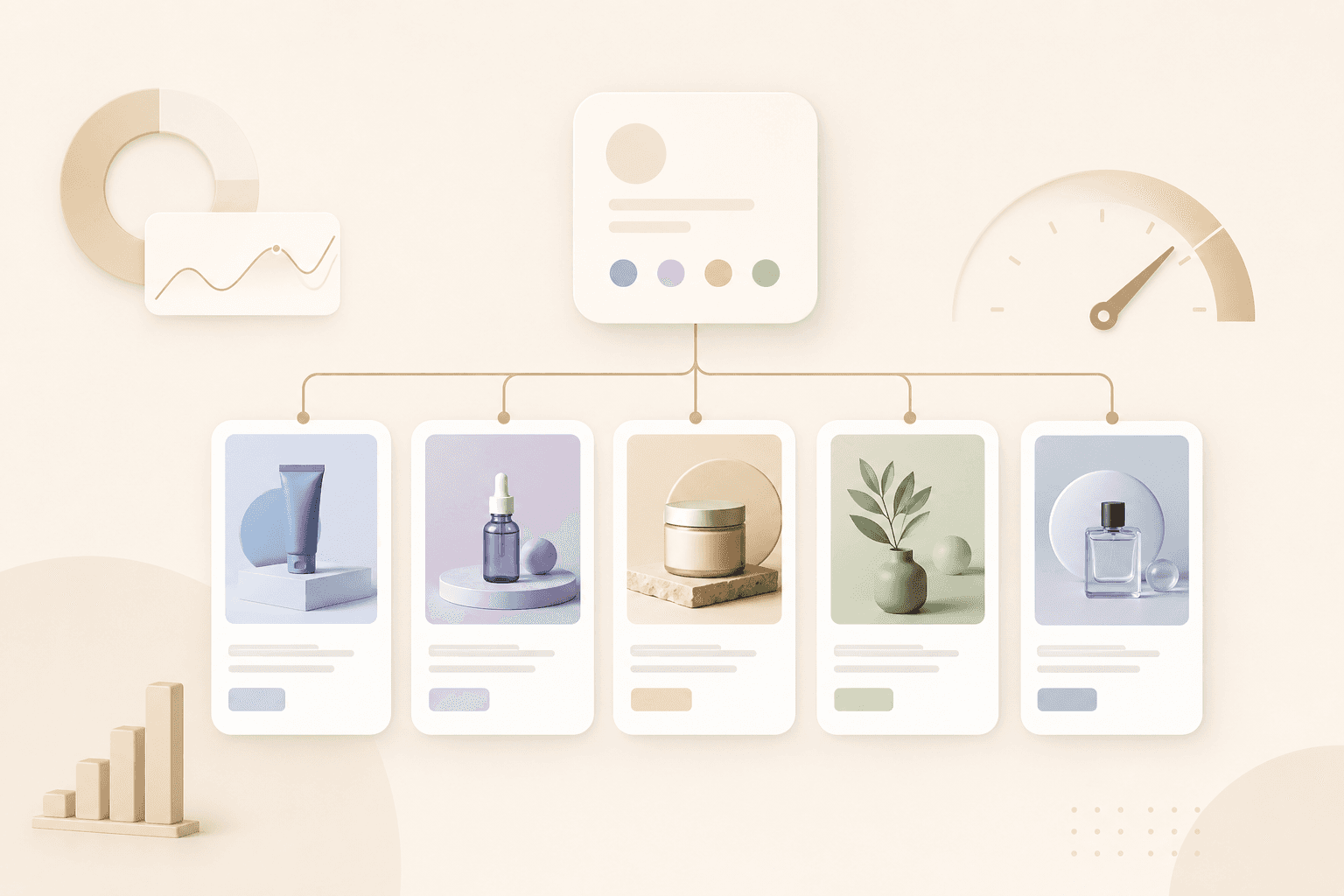
We recommend grouping ad sets by distinct creative theme or format, so if you have 5 ad concepts and 5 iterations of each concept, you would group them into 5 adsets, similar to the below image:
Use Campaign Budget Optimization to let Meta fluidly allocate spend to the ad concepts that it thinks will perform best. If you are concerned about not getting enough spend on a particular concept, you can always apply a daily spend minimum to the adset to force it to spend, without compromising the overall performance of the campaign.
Once you have identified a top variant in each adset (typically this does not change after ~$20 in total spend per concept, regardless of your overall daily budget), you can start to scale them into a "Winners" campaign.
CBO vs ABO in 2026
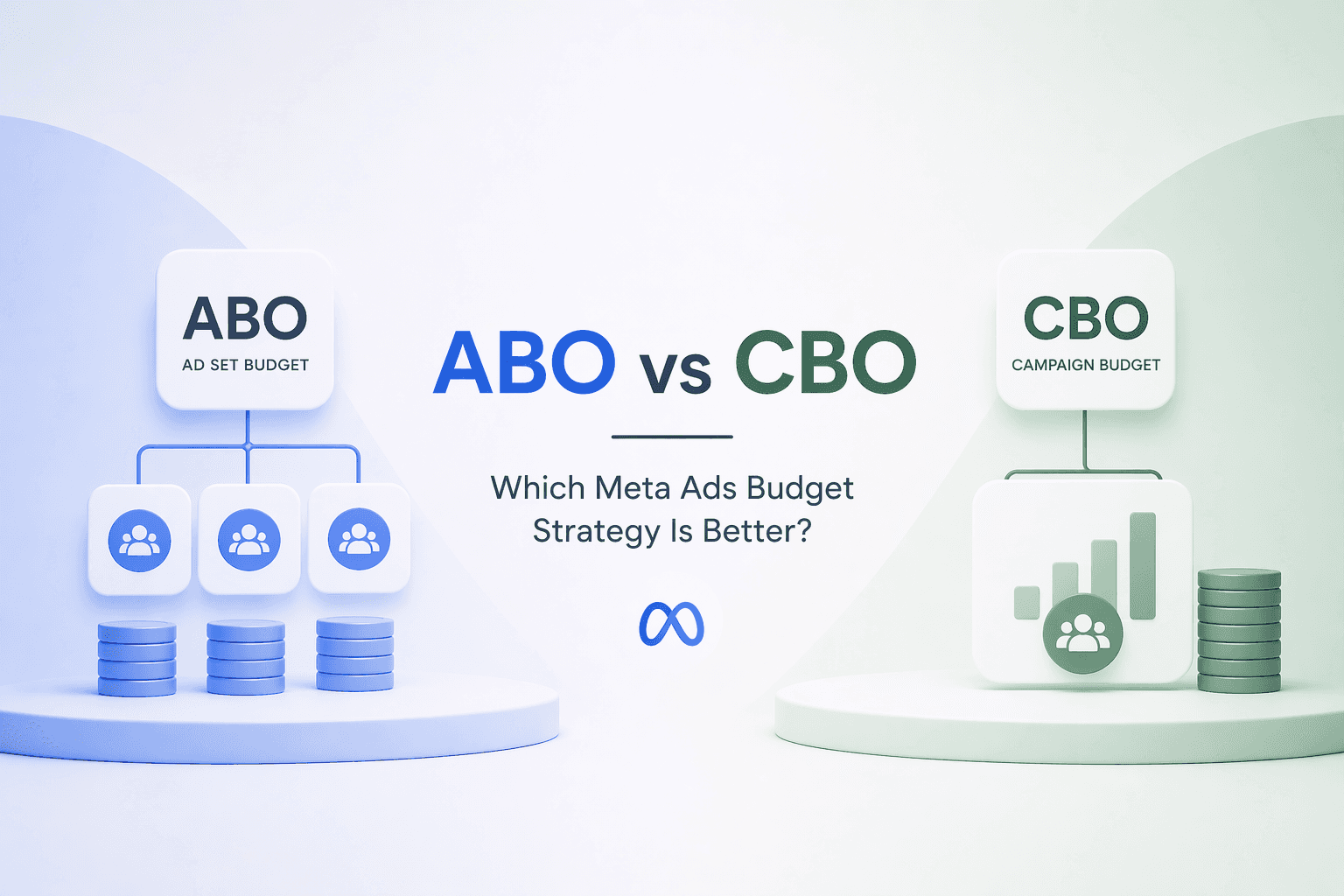
A question we still get weekly: should budgets sit at the campaign level (CBO, now Advantage+ campaign budget) or the ad set level (ABO)? In 2026 the answer is both, for different jobs. CBO is the default across this entire structure, because letting Meta move budget fluidly to the concepts and audiences it trusts is exactly what its delivery is now good at. ABO's remaining role is control: if you need to guarantee spend on a specific concept or audience (a new product line, a mandated test), a small ABO campaign or an ad set spend minimum inside CBO does the job. What you should not do is run your scale spend in rigid ABO ad sets, since fighting Meta's allocation almost always costs efficiency at scale. In short: structure on CBO, reach for ABO (or spend minimums) only when you need to force delivery.
Your Meta ads campaign structure is the highest-impact decision you make before a single dollar goes live. Get it right and Meta's machine learning has a clean, dense signal to optimize against. Get it wrong and you fragment budget, starve ad sets, and fight the algorithm.
Most accounts we audit break the same way. They run too many campaigns and split one audience across too many ad sets. No single ad set ever collects enough conversions to stabilize.
Meta's Andromeda update rewired how ads get matched to people. Per Meta's own engineering team, advertisers who newly turned on Advantage+ creative's AI-driven targeting saw a 22% increase in ROAS (return on ad spend). That shift rewards simple accounts that feed the system volume.
This guide lays out the account and Meta ad campaigns structure we run at Flighted in 2026. It covers testing, scaling, and audience decisions for DTC, plus a dedicated B2B SaaS variant, with every rule anchored to a threshold. For vertical detail, see our guides for supplement brands, telehealth, and B2B SaaS.
This is written for operators spending five to six figures a month. If you run Meta in-house or manage it for clients, the thresholds below are the ones we act on. Read it as a build spec, not theory.
Essential Takeaways:
Segmenting your account into "Test" and "Scale" campaigns is essential to allow for high creative testing velocity, without resetting your largest campaigns into the learning phase
Meta can now handle a larger volume of ads per adset - your highest spending campaigns can handle more creative than ever before
You don't need to segment ads by format (static and video) - simply consolidate your top performing ads together, and trust Meta's Advantage+ Targeting to build a cohesive funnel in a single adset with your creative
Test a wide array of audience targeting including Advantage+, Broad, themed interest stacks, and varying Lookalike sources and sizes (1 to 3 percent tend to work best)
Spend less on retargeting than you would assume
Start With The Philosophy Behind This Structure
If you're new to Meta advertising, understand the principles before the diagram, because every structural rule below flows from them. Master these and you'll operate above most Meta advertisers.
Simple structures win. Every extra campaign, ad set, and exclusion is another constraint on Meta's delivery and another place for the learning phase to reset. The algorithm performs best with a clean, consolidated surface to optimise against, which is why the entire structure below reduces to three campaigns.
Machine learning runs on data density. Meta's delivery learns from conversion volume. Splitting the same budget across many small ad sets starves each one of signal; consolidating spend into fewer, well-fed ad sets gets you out of the learning phase and into stable delivery faster.
Respect the Breakdown Effect. The ads driving the most value in your account often display the worst in-platform ROAS or CPA numbers, because Meta strategically pushes spend toward ads with the highest scaling potential. A beginner's instinct is to pause the high-spend, "inefficient" ad and force budget into the efficient-looking ones. That's almost always a mistake: the high spender is usually the incrementality driver introducing your brand to new audiences, while the efficient-looking ads close sales it originated. Pause it and the whole ad set can collapse. This is covered in depth in the Identifying Winning Ads section below.
Think in incrementality, not attribution. Platform-reported numbers tell you what Meta claims; incrementality tells you what your ads actually caused. Judge the account on blended results and new-customer reach, not on which ad set wins the attribution race.
Protect funnel health. An account that only harvests warm demand will look efficient right up until it stalls. Watch First-Time Impression Rate and keep dedicated pressure on new-to-file reach, which is exactly what the Top-of-Funnel campaign below exists to do.
The 2026 DTC Account Structure At a Glance
Skip the theory for a second, here's the structure itself. Most DTC brands spending $5K-$100K/month should run exactly three campaigns:
Campaign 1: Sandbox / Test (CBO)
Budget: 25% of total daily spend
Structure: One ad set per creative concept, grouped by theme or format
Purpose: Identify likely winners at roughly $20 spend per concept, independent of your overall budget
Campaign 2: Winners (CBO)
Budget: The majority of remaining spend
Structure: One consolidated adset holding only proven post-ID winners from Sandbox, tested across audience types (Broad, Advantage+, Lookalike Stacks, Purchaser Lookalikes)
Purpose: Your primary scale engine, held stable on creative, variable on audience
Campaign 3: Top-of-Funnel
Budget: Sized to keep your blended First-Time Impression Rate above 60% account-wide
Structure: Exclude every audience you can, website visitors, existing customers, ad engagers, past converters, the works. This campaign exists to reach people your account hasn't touched yet.
Optimization event: An upper-funnel signal like Add-to-Cart rather than Purchase. Forcing this campaign to optimize for last-click conversion defeats its purpose, it needs room to reach cold, unproven audiences without Meta immediately narrowing back toward your warmest prospects.
Purpose: Without a dedicated campaign actively pushing for new-to-file reach, your Winners campaign will quietly drift toward the easiest, most familiar audiences over time, First-Time Impression Rate decays, and your total addressable audience shrinks even as in-platform ROAS looks fine. This campaign is the counterweight.
Retargeting: deliberately not a fourth campaign, yet. Skip a dedicated retargeting build entirely until you're spending close to $1K/day across Sandbox + Winners + Top-of-Funnel combined. Below that threshold, exclusion match rates are unreliable enough post-iOS 14 that your Winners campaign is already recapturing a meaningful share of warm traffic without a second budget line. Once you cross that spend level, add retargeting at under 10% of total budget, cart-abandonment and high-value SKUs only, not a general warm-audience catch-all.
Structure By Spend Level
The campaign structure barely changes as you scale. What changes is how many ad sets each campaign holds and how much creative you feed them.
Monthly Spend
Recommended Campaigns
Notes
Under $5K
Sandbox + Winners
One combined top-of-funnel push; keep ad sets few.
$5K–$25K
Sandbox + Winners + Top-of-Funnel
Full three-campaign spine; still no dedicated retargeting.
$25K–$100K
Same three campaigns, more ad sets
Add retargeting under 10% once past ~$1K/day.
$100K+
Three campaigns plus Advantage+ tests
Break Advantage+ into its own campaign for clean reads.
The temptation at every level is to add campaigns, but resist it. Adding budget to your existing ad sets almost always beats spinning up new ones, because it feeds the learning phase. Only add structure once a single ad set is genuinely over-fed.
Keep naming and reporting boring on purpose. Use a consistent convention so anyone can read the account at a glance. A predictable structure is easier to audit, hand off, and scale than a clever one.
Top-Of-Funnel Structure For A New DTC Brand
New DTC brands have no purchase history, so treat the top of funnel as a data-gathering engine. Exclude all warm audiences. You want net-new prospects only.
Set the exclusions deliberately. Exclude website visitors, past purchasers, email lists, and social engagers. A new brand has little warm audience to spare, and leaks into the top of funnel inflate your reported results.
Optimize for an upper-funnel event, Add-to-Cart, not Purchase. Early on you will not generate enough purchases to teach the algorithm, so a cheaper mid-funnel event gets you to volume faster. For the sequencing logic, see our upper-funnel Meta ads strategy guide.
Keep blended FTIR above 60% so you keep reaching fresh users. Then size the budget from learning-phase math: Meta wants about 50 conversions per ad set per week to exit the learning phase. Ramp toward that number and hit roughly 25 per week by mid-month.
A conservative first-month CPA estimate is roughly your product price. An $80 product at 25 conversions per week runs ($80 × 25) × 4 weeks, or about $8,000 per month. Our bare-minimum engagement floor is about $250 per day.
Do the arithmetic before you launch, not after. If your budget cannot buy roughly 25 conversions a week at your expected CPA, the ad set never leaves learning. When budget is tight, optimize for a cheaper event so you still clear the weekly bar.
As purchase volume builds, move the optimization event down the funnel toward Purchase. Do it in one step, not gradually, and give the ad set a fresh week to relearn. Rushing this shift is how new brands stall their first scale.
How To Test New Ads on Meta
To maintain a high testing velocity without compromising performance, follow these "Sandbox" campaign rules:
Budget: Limit spend to 25% of your total daily ad spend.
Structure: Group ad sets by distinct creative themes or formats.
Optimization: Use Campaign Budget Optimization (CBO) to let Meta find the best variants.
Spend Minimums: Apply ad set spend minimums only if a concept isn't getting enough delivery.
We recommend grouping ad sets by distinct creative theme or format, so if you have 5 ad concepts and 5 iterations of each concept, you would group them into 5 adsets, similar to the below image:
Use Campaign Budget Optimization to let Meta fluidly allocate spend to the ad concepts that it thinks will perform best. If you are concerned about not getting enough spend on a particular concept, you can always apply a daily spend minimum to the adset to force it to spend, without compromising the overall performance of the campaign.
Once you have identified a top variant in each adset (typically this does not change after ~$20 in total spend per concept, regardless of your overall daily budget), you can start to scale them into a "Winners" campaign.
CBO vs ABO in 2026
A question we still get weekly: should budgets sit at the campaign level (CBO, now Advantage+ campaign budget) or the ad set level (ABO)? In 2026 the answer is both, for different jobs. CBO is the default across this entire structure, because letting Meta move budget fluidly to the concepts and audiences it trusts is exactly what its delivery is now good at. ABO's remaining role is control: if you need to guarantee spend on a specific concept or audience (a new product line, a mandated test), a small ABO campaign or an ad set spend minimum inside CBO does the job. What you should not do is run your scale spend in rigid ABO ad sets, since fighting Meta's allocation almost always costs efficiency at scale. In short: structure on CBO, reach for ABO (or spend minimums) only when you need to force delivery.
Want this structure built for you, and 25+ ads per month?
We're a small, hard-working, US-based team. Book a call and get a free Meta Ads audit today.
Account Structure Benchmarks: When to Move to the Next Stage
Each stage of your account structure has a spend or volume threshold that tells you it's time to promote or pause. Don't rely on gut feel, use these as your graduation checkpoints:
Stage
Threshold to Watch
What It Tells You
Next Action
Sandbox / Test Campaign
~$20 total spend per concept
Enough signal to identify a likely winner, largely independent of your overall daily budget
Promote the top variant per adset into your Winners campaign
Winners Campaign (CBO)
1 full week of spend across all audience variants before pausing any
Statistically reliable read on which targeting method is most efficient
Pause worst-performing audiences, double down on highest spender (not lowest CPA, see Breakdown Effect)
Advantage+ Campaign
7-day frequency comparison against your top CBO audience
Whether Advantage+ is out-delivering manual targeting on CPA, and how much it leans on retargeting
Shift budget toward whichever campaign type is winning after the comparison window
Ad set volume
10-20 active ads spanning formats/angles per high-spending campaign
Enough creative diversity for Meta's Andromeda/Lattice systems to avoid clustering near-duplicate ads
Repurpose winning messaging into new formats rather than adding more iterations of one hook
A quick gut check before promoting anything: don't judge by conversion volume or CPA alone. The Breakdown Effect means Meta will intentionally push more spend toward higher-scaling ads even if their individual CPA looks worse, pausing that ad can collapse performance across the whole campaign.
Scaling Your Creative Winners
Scaling winners in the campaign structure is a consolidation exercise, not an expansion one. Take your top Post IDs and scale them into one consolidated Winners ad set. Spend and social proof then compound in a single place.
Inside that ad set, test these audiences against each other:
Broad targeting, no interests.
Advantage+ audience.
Engaged Shoppers.
Lookalike Stacks at 1–3%.
Purchaser Lookalikes at 2–5%.
Let Meta decide where spend lands. Do not build a separate ad set per audience, because that fragments the conversions each one needs. One well-fed ad set with five audience inputs beats five thin ad sets.
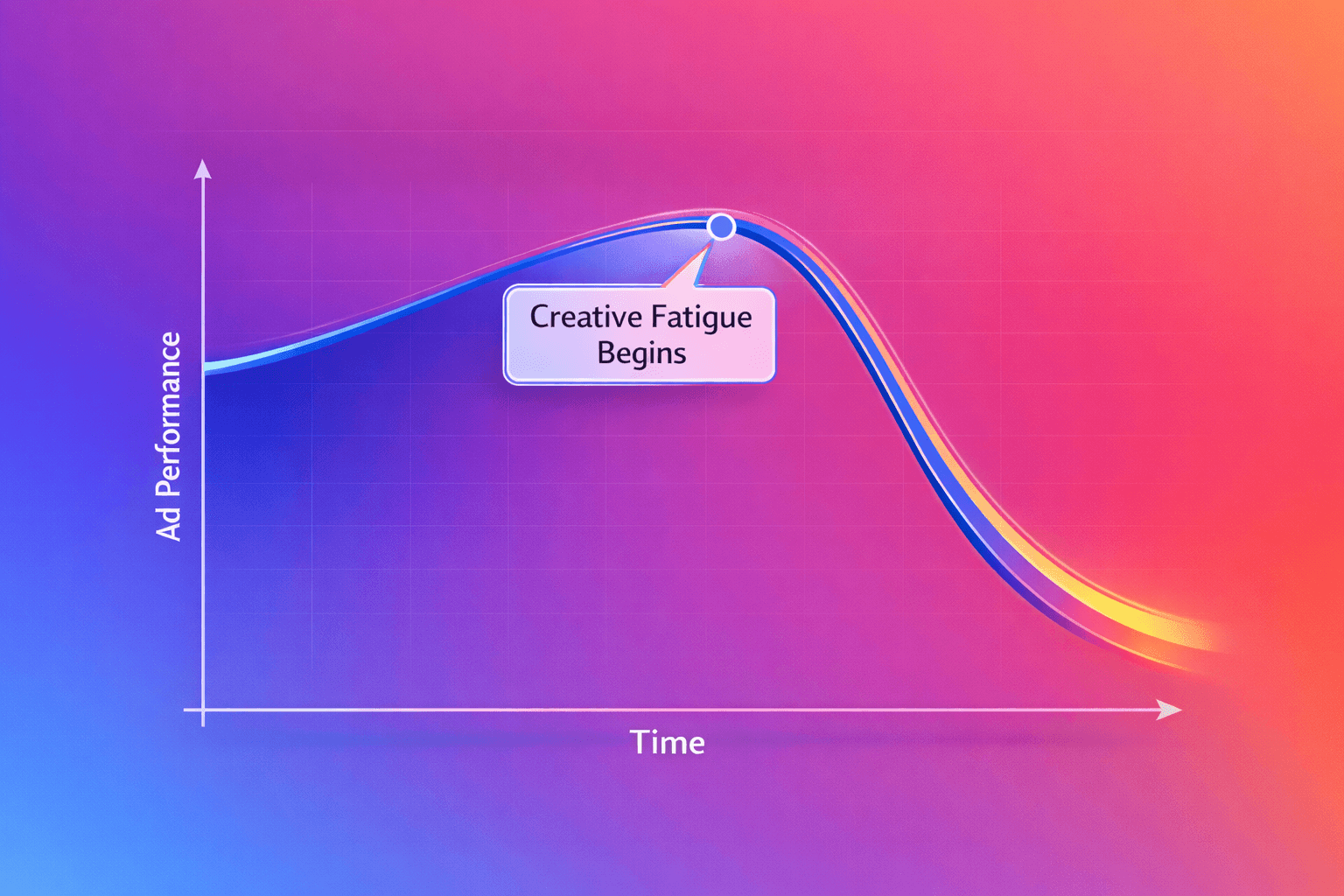
Refresh the Winners ad set on a schedule, not in a panic. When a Post ID's 7-day frequency climbs past 3–4 and CPA drifts up, rotate in the next graduate from the Sandbox. The Winners campaign should always hold your three to five strongest concepts.
Do not over-manage the audiences inside a working ad set. Once it is stable, resist the urge to prune the inputs Meta is not spending on. Those inputs give the system room to shift as fatigue sets in, which protects performance during creative transitions.
Scaling Your Account by Spend Level
Account structure isn't static, it evolves as spend climbs, and creative volume needs to climb with it. Use this as your checkpoint system rather than scaling on gut feel:
Stage
Monthly Spend
Active Creatives Needed
What You're Solving For
Foundation
Under $3K
5-8
Proving Meta can profitably acquire customers for your product at all
Validation
$3K-$10K
8-12
Confirming your winning angle holds up as spend increases
Acceleration
$10K-$25K
12-20
Expanding audiences while fighting creative fatigue, this is where most accounts plateau
Expansion
$25K-$50K
20-35
Running this like a media-buying operation, not a testing sandbox
Optimization
$50K+
35-50
Grinding for 1-2% efficiency gains rather than big structural wins
If creative volume lags spend, frequency climbs, FTIR falls, and CPA drifts up. Scaling spend without scaling creative is the most common way brands stall at a ceiling.
Match your production pipeline to the phase you are entering, not the one you are in. New concepts need a week in the Sandbox before they carry scaled spend. A creative backlog is not optional.
Vary format as well as volume. A pipeline of only statics fatigues faster than a mix. Aim for a blend of UGC-style video, direct-response statics, and carousels so Advantage+ has real variety to choose from.
Treat creative as the lever that unlocks the next spend tier. When performance plateaus, the fix is almost always fresh concepts, not another audience. Ship new angles before you raise budgets.
Identifying Winning Ads and Audiences
The Breakdown Effect makes naive reads dangerous. Break a consolidated ad set into slices and the slices look worse than the whole. So do not judge an ad by last-click CPA alone.
Two rules keep you honest. First, do not pause your top spender just because its reported CPA looks high; it often carries incremental volume the model misses. Second, check blended results and MER before you cut anything.
Reconcile two views before every decision. Use in-platform numbers for creative-level reads, then use blended MER and back-end revenue for spend-level decisions. When the two disagree, trust the blended number for budget and the in-platform number for which creative to cut.
When you decide what to scale, watch these signals together:
Blended MER holding or improving as spend rises.
FTIR staying above 60% at the top of funnel.
7-day frequency under roughly 3–4 on scaled ad sets.
New-customer share of revenue trending up.
Any single metric can mislead. Read them as a set, and let the direction of all four decide whether you push budget or hold.
Set a review rhythm you can hold to. Check pacing daily, but make scaling calls weekly on blended numbers. A steady cadence keeps you from chasing noise and reacting to a single soft day.
Broad Targeting vs. Detailed Targeting: Which to Use
Broad targeting wins when your creative is strong and your budget can feed volume. Meta's delivery system reads creative signals and finds buyers faster than manual interest stacks. As budgets grow, broad almost always pulls ahead.
Detailed or interest targeting still wins in narrow cases: small budgets, niche products, or launches where you must force early relevance. Under $1,000 per day on a specialized product, a tight interest stack can concentrate limited conversions where they matter.
Do not argue about it in a meeting. Use Meta's built-in A/B test tool and run broad against detailed for 7–14 days. Keep the creative identical and call the test only once each cell clears a meaningful number of conversions.
A few practical guardrails for the test:
Split the audiences cleanly so the two cells do not overlap.
Give each cell enough budget to clear its weekly conversion bar.
Read blended MER, not just in-platform CPA, before you pick a winner.
In most scaled accounts, broad wins and detailed becomes a niche tool. Keep one or two interest tests running as a hedge, but let broad carry the volume once your creative is proven.
Testing Advantage+ Targeting Campaigns
As of the time of this writing, you can technically now run Advantage+ targeting adsets in the same campaigns as adsets using manual targeting (Broad, Lookalikes, etc). However, we still recommend breaking Advantage+ Targeting adsets out into their own campaigns, because they often serve a different purpose in the funnel. They tend to have the best CPA in your ad account, but can be slightly more middle-of-funnel than traditional Meta audiences, which may look worse in the ad account but be more incremental for your business.
Once you have identified a winning audience in your CBO campaign (meaning the highest spending, not necessarily the lowest CPA adset due to the breakdown effect described above), you should pause your poorer performing adsets. Move your winning ads into a dedicated Advantage+ Campaign using Meta's Advantage+ Targeting on the adset level. See how the CPA compares to your top performing audience campaign. Make sure to note the frequency of each campaign over a 7 day period, as your Advantage+ campaign may gravitate to more retargeting than your CBO campaign.
If you're...
Use...
Because...
Just identified a winning ad and haven't tested audiences yet
CBO with Broad, Advantage+, Lookalike Stacks, and Purchaser Lookalikes running in parallel
You need a week of data across methods before you know which audience is most efficient for this specific business
Comparing which audience method is most efficient
CBO, consolidated into one adset per targeting method
Lets Meta fluidly allocate spend within each method while you compare methods against each other
You've already identified your best-performing CBO audience
Advantage+ Campaign (separate from CBO), using the same winning creative
Advantage+ typically posts the best CPA in the account, but keeping it in its own campaign lets you isolate its frequency and funnel position from your CBO numbers
Your Advantage+ CPA looks best but frequency is climbing fast
Stay on CBO, or split budget
Advantage+ may be leaning heavily on retargeting rather than net-new reach, check the 7-day frequency comparison from the benchmarks table above before shifting more budget
You're not sure if a concept is ready to scale
Neither, back to Sandbox/Test
Under ~$20 spend per concept, you don't have enough signal to know if it's a real winner or noise
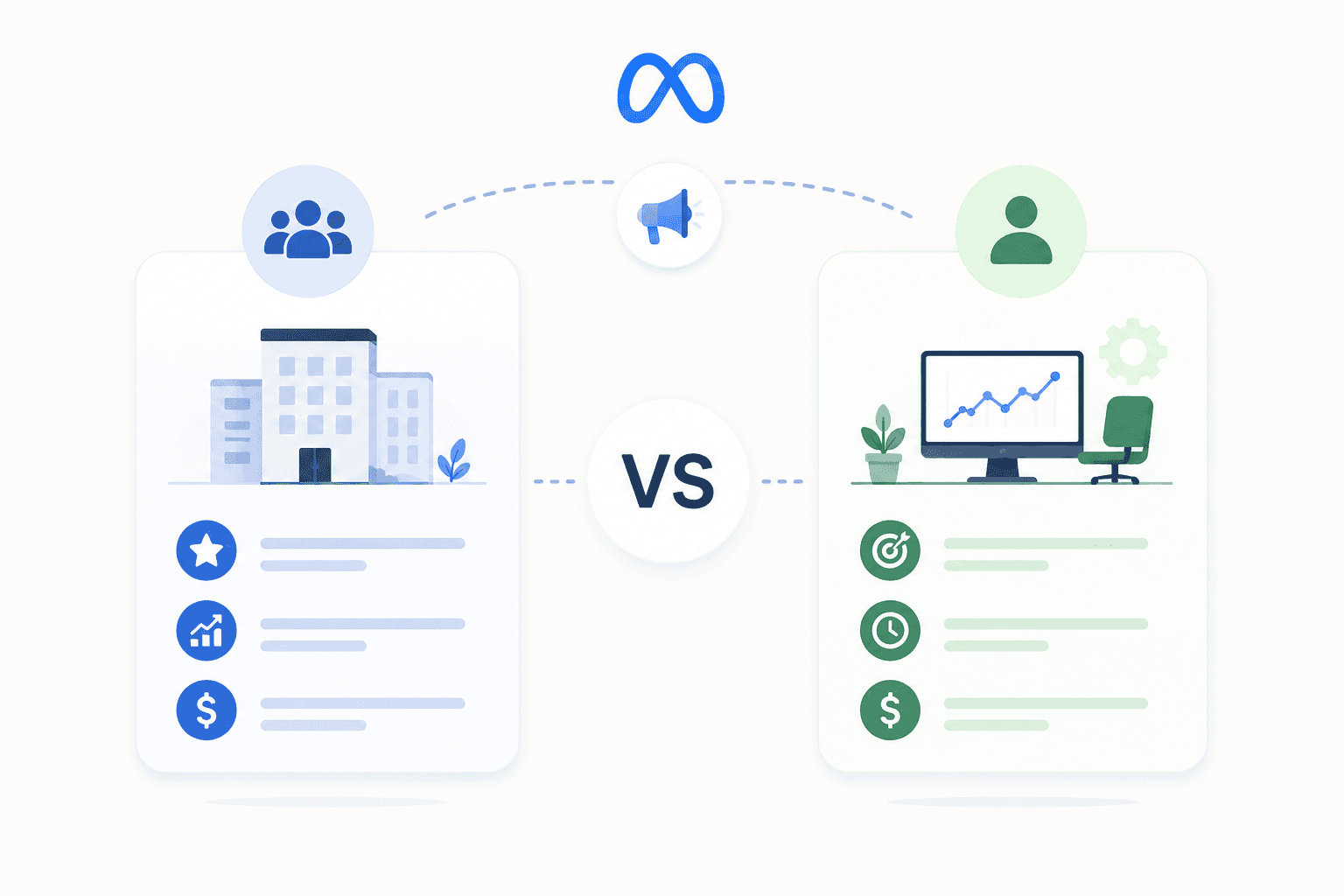
10. Meta Ads Structure For B2B SaaS
B2B SaaS uses the same Sandbox-to-Winners spine, but the optimization events change because a lead is not a sale. Structure the account to teach Meta what a good lead looks like. For the full sequence, see our B2B SaaS Meta ads funnel guide.
The core failure mode in B2B is optimizing toward cheap leads that never become pipeline. Feed Meta only raw form-fills and it gets good at finding form-fillers, not buyers. Structure the account so the platform learns your definition of a good lead early.
Every SaaS account needs two conversion events at minimum. First is a Lead event, which fires when someone books a demo or starts a free trial. Second is a Qualified Lead event, which fires only when that lead meets your qualification bar.
"Qualified" is a business definition, not a platform setting. Flighted's internal bar is annual revenue of at least $500,000 per year. Set the threshold before you build, because it drives which leads you feed back to Meta.
There are two ways to send "qualified" back to the platform:
Form-field pixel event via Google Tag Manager (GTM): fire it only when a qualifying value is selected, such as employee count of 2 or more.
CRM stage change via CAPI: send a server-side event through the Conversions API when a CRM stage changes to MQL, SQL, or Qualified.
The CRM route works with HubSpot, Salesforce, or GoHighLevel. Send both signals when you can. Meta performs better when it can tell people who convert from people who convert and are a good fit.
On the audience side, B2B still rewards consolidation. Feed one well-fed ad set these inputs and let delivery sort them:
Broad targeting, no interests.
Lookalikes built from your closed-won customer list.
Lookalikes built from your Qualified Lead event.
A retargeting layer once spend supports it.
Keep the creative job-to-be-done specific. B2B buyers respond to concrete pain points, proof, and outcomes, not brand fluff. Test hooks the same way you would for DTC, one concept at a time in the Sandbox.
Sequence the account by volume, not by ambition. Optimize for the Lead event early, because it fires often enough to teach delivery. Graduate an ad set to the Qualified Lead event only once qualified volume can approach the weekly bar.
The same learning-phase math applies. Ramp each optimizing ad set toward roughly 50 conversions per week, hitting about 25 by mid-month. If qualified leads are too rare, keep optimizing for the Lead event and use qualification as a reporting layer until volume catches up.
Consolidation is the safe default here too. In Meta's launch study of 15 A/B tests, Advantage+ shopping drove 12% lower cost per purchase versus business-as-usual campaigns, per Meta. The lesson carries to lead-gen: fewer, better-fed ad sets beat many thin ones.
Measure B2B on pipeline, not platform. Meta's reported cost per lead is a leading indicator, not the scorecard. Judge the channel on cost per qualified lead and, eventually, cost per closed-won deal from your CRM.
11. Meta Ads Campaign Structure Best Practices For 2026
These are the core rules of the Meta ads campaign structure above, in one scannable list. They double as our answer to "meta ads best practices 2026." For deeper tactics, see our guide to Meta ads best practices for 2026.
Advantage+ shopping now accounts for about a third of US retail Meta ad spend, per Tinuiti (Q2 2025). A clean, consolidated structure that feeds it is table stakes.
Run three campaigns. Sandbox, Winners, and Top-of-Funnel cover most accounts.
Feed the learning phase. Concentrate budget so each ad set clears ~50 conversions per week.
Consolidate creative and formats. Load video, statics, and carousels together and let Advantage+ pick the mix.
Scale creative with spend. Keep roughly 2 active creatives per $1,000 in daily spend.
Judge on incrementality. Use blended ROAS and MER, not last-click CPA alone.
Protect funnel health. Keep FTIR above 60% and watch 7-day frequency for fatigue.
Send clean signals. Use server-side CAPI so measurement survives ATT opt-outs.
Treat these as a monthly checklist, not a one-time setup. Accounts drift: ad sets multiply, budgets outrun creative, and old campaigns linger. Once a month, prune structure back to the three-campaign spine and cut anything that no longer earns its place.
Frequently Asked Questions
What is the structure of a Meta ad campaign?
A Meta ad campaign has three levels: campaign, ad set, and ad. The campaign sets the objective, such as sales or leads. The ad set controls budget, audience, and placements, and the ad holds the creative people see.
How do I organize my Meta ads?
Run three campaigns, not a dozen. Use a Sandbox for new creative, a Winners campaign for proven ads, and a Top-of-Funnel campaign for cold prospects. Keep budget in few ad sets so each clears roughly 50 conversions per week.
What is the 3-2-2 method in Facebook ads?
The 3-2-2 method is a beginner template: 3 campaigns, 2 ad sets each, and 2 ads per ad set. It gives new advertisers a simple starting grid. We prefer consolidation, because splitting a small budget across fixed ad sets starves each of the roughly 50 weekly conversions Meta needs.
Is $10 a day enough for Facebook ads?
Usually no. Meta wants about 50 conversions per ad set weekly to exit the learning phase. At a $40 CPA, $10 a day buys under two conversions daily, and our floor is about $250 per day.
What is the best format for Meta ads?
There is no single best format. Load a mix of UGC-style video, direct-response statics, and carousels, then let Advantage+ decide what serves each person. Consolidate formats inside fewer ad sets so delivery has enough signal to pick winners.
Summary
Keeping your test campaign separate from multiple higher-spending scale campaigns is the best way to manage a stable Meta ad account, while still allowing for constant creative testing. If you start to struggle with scaling your creative winners, you can always launch consolidated groups of promising ads into "challenger" adsets in your CBO campaign, just to reduce the risk of false negatives.
If you're looking for a best-in-class Meta advertising agency to assist with your Meta ads account structure and your creative strategy more broadly, consider getting in touch and booking a free call with us! We're a small, hard-working, US-based team.